
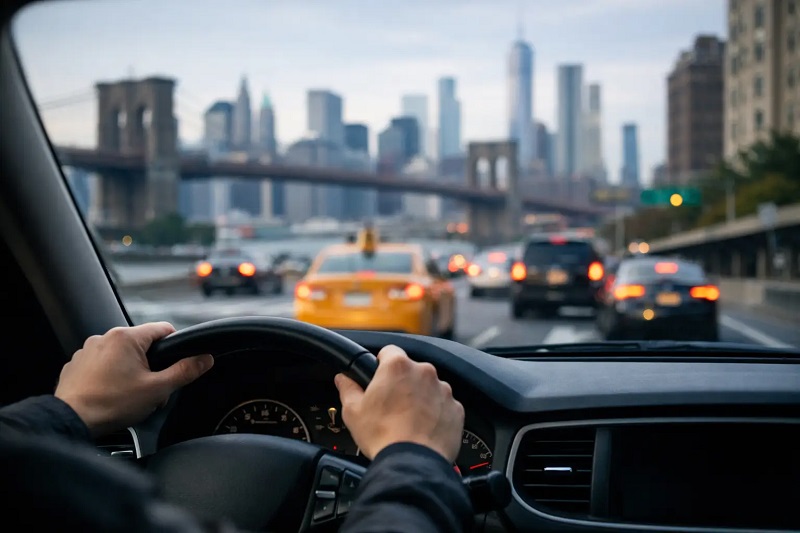

For anyone struggling with driving anxiety, few experiences are as isolating as sitting at the foot of an interstate on-ramp. Your heart thumps against your ribs, your palms leave slick imprints on the steering wheel, and your field of vision narrows into a tight, frantic tunnel. What should be an ordinary twenty-minute trip across town turns into a high-stakes calculation. Many drivers will willingly add forty-five minutes of stop-and-go traffic, endless red lights, and confusing backroads to their daily commutes just to avoid a four-mile stretch of multi-lane highway.
This avoidance is rarely about a lack of driving skill. Most people who fear the highway know how to steer, brake, and parallel park with ease. The issue is neurobiological: high speeds, wide asphalt expanses, and the perceived inability to pull over trigger an ancient fight-or-flight mechanism. Your brain misinterprets rapid motion and close quarters as an existential emergency. Reclaiming your mobility requires understanding why high-speed travel short-circuits your nervous system, learning practical in-cabin calming tactics, and rebuilding your tolerance through deliberate, structured exposure.
Deconstructing the Panic Loop Behind the Wheel
To disarm highway fear, you have to examine why the interstate feels so threatening compared to a city boulevard. The first culprit is optic flow—the sheer velocity at which visual data moves past your retina. At twenty-five miles per hour, your brain has ample processing time to catalog every mailbox, parked car, and pedestrian. At seventy miles per hour, the landscape rushes past at roughly one hundred feet per second. This sensory surge can easily overwhelm a nervous system that is already sensitized to stress.
The second factor is the feeling of entrapment. On residential or commercial streets, an anxious driver has access to immediate relief valves: gas stations, strip mall parking lots, turn lanes, and side streets. If panic flares, you can turn right and take a breather. On a limited-access freeway, you are committed to the road until the next exit ramp. If exits are spaced two or three miles apart, your brain perceives that gap as a trap, and that perceived lack of escape accelerates catastrophic thinking.
Yet from an objective engineering standpoint, modern controlled-access freeways are among the safest thoroughfares ever built. Every vehicle travels in the exact same direction, eliminating the risk of head-on collisions. There are no sudden red lights, no cross-traffic running stop signs, no bicyclists swerving into travel lanes, and no pedestrians stepping off curbs. The danger feels immense because the speed is high, but the predictability of highway traffic is far greater than that of a chaotic surface street.
Tactical In-Cabin Grounding Techniques
When an adrenaline surge strikes while you are traveling sixty-five miles per hour, you cannot pull over immediately, nor should you panic-brake. You must manage your autonomic nervous system from the driver’s seat.
Interrupt the Physical Feedback Loop
Anxiety creates physical tension, and that physical tension signals the brain to release even more adrenaline. The most common physical reaction is the death grip on the steering wheel, accompanied by shoulders hitched up to the earlobes and teeth clenched tight.
-
Relax your fingers: Consciously open your fingers and rest your hands lightly on the lower third of the steering wheel. Tap your fingers lightly against the leather to remind your body that you are holding the controls, not wrestling them.
-
Drop your shoulders: Exhale forcefully and let your shoulder blades slide down your back.
-
Anchor your left foot: Press your left foot firmly into the dead pedal on the floorboard. Physical pressure against a stable surface provides proprioceptive feedback, grounding your spatial awareness within the cabin.
Use the Physiological Sigh
Deep breathing advice often fails during panic because people accidentally hyperventilate by inhaling too deeply without expelling carbon dioxide. Instead, use the physiological sigh.
Take two quick, consecutive inhales through your nose—one deep inhale, followed immediately by a sharp second top-off inhale—then release a long, slow exhalation through pursed lips until your lungs are completely empty. Repeating this sequence three times forces your heart rate to slow by directly stimulating the vagus nerve, blunting the acute adrenaline rush in seconds.
Expand Your Visual Scan
Anxiety produces tunnel vision, causing drivers to fixate nervously on the asphalt directly in front of their bumper or stare at the brake lights of the single car ahead. This myopic focus magnifies the feeling of speed.
Force your eyes to look fifteen to twenty seconds down the road, scanning the distant horizon. In defensive driving, this is called high-aim steering. Looking far ahead slows down your perception of optical speed, gives your brain plenty of time to anticipate traffic shifts, and naturally steadies your steering inputs.
Systematic Desensitization: Rebuilding Tolerance Step by Step
Attempting to conquer highway phobia by forcing yourself into a sixty-mile road trip during Friday evening rush hour is a recipe for severe setback. Phobias are dismantled through gradual, non-traumatic exposure that steadily expands your comfort zone.
Level One: The Dawn Single-Exit Run
Begin on a Sunday morning at sunrise. The roads are empty, the lighting is clear, and commercial truck traffic is minimal.
Your objective is simple: navigate down the on-ramp, merge into the far-right lane, maintain highway speed for exactly one exit, and take the off-ramp back onto surface streets. That is your entire assignment. Do this two or three times over a single weekend until the physical dread at the top of the ramp drops from an overwhelming roar to a manageable murmur.
Level Two: Stringing Exits Together
Once a single exit feels routine, extend your exposure. Drive two exits before leaving, then three, then four.
Maintain this practice exclusively during off-peak windows—mid-morning on a Tuesday, or early afternoon on a Saturday. Your objective during this phase is adjusting to the sensation of sustained speed. Pay attention to how your nervous system naturally habituates: even if anxiety spikes when you merge, adrenaline typically plateaus and begins to recede after eight to ten minutes of steady cruising. Learning that panic has an expiration point, even while remaining on the highway, is transformative.
Level Three: Integrating Moderate Traffic
Only after off-peak driving feels predictable should you introduce moderate mid-day traffic. Do not jump straight to torrential rainstorms or holiday getaways. Add one complexity at a time, proving to your rational brain that your vehicle handles predictably regardless of how many other motorists share the pavement.
Navigating Highway Flashpoints with Strategy
Anxious drivers usually have specific pain points that trigger their sharpest fears. Having clear mechanical game plans for these moments removes uncertainty.
The On-Ramp Acceleration Problem
The number-one mistake nervous motorists make is creeping down the acceleration ramp at forty miles per hour, hoping to find an opening once they reach the highway. This creates an exceptionally hazardous speed differential.
The on-ramp is designed as a runway. Use it to match the prevailing speed of traffic before you reach the dashed lines. When your vehicle matches the pace of the lane you want to enter, merging requires only a modest lane transition into an open pocket, rather than forcing high-speed traffic to brake aggressively around you.
Passing Commercial Semi-Trucks
Tractor-trailers are loud, physically intimidating, and displace large volumes of air that can buffet a passenger car.
Never linger in a semi-truck’s blind spots, particularly along the right side or directly beside the tractor cab. If you must pass, hold back slightly until the lane ahead of the truck is completely clear. Once an opening exists, accelerate smoothly past the truck with purpose. Maintain your lane position and do not cut back in front of the truck until you can clearly see both of its headlights in your rearview mirror.
Strategic Lane Management
Nervous drivers often gravitate toward the far-right lane because it sits next to the shoulder, assuming it offers the safest sanctuary. In reality, the far-right lane is the most chaotic lane on a busy freeway due to vehicles constantly entering, exiting, and merging. Conversely, the far-left lane invites aggressive drivers and tailgaters.
On a highway with three or more lanes, the center lane is almost always the calmest place to drive. It allows you to set your cruise control at the posted speed limit, avoids the turbulent shuffle of entering traffic on the right, and leaves the left lane open for drivers who wish to pass.
Preparing the Cockpit Before Turning the Key
Removing small operational frictions before you leave the driveway protects your cognitive bandwidth for the road itself:
-
Eliminate Blind Spots: Adjust your side mirrors outward until your own car’s rear quarter panels just disappear from view. When properly aligned, a vehicle leaving your rearview mirror appears immediately in your side mirror, reducing the need for panicked, neck-straining over-the-shoulder checks.
-
Control the Audio: Avoid driving in dead silence, which allows catastrophic internal monologues to run uninterrupted. Choose an engaging podcast, an audiobook, or familiar music played at a modest volume to keep the verbal centers of your brain grounded.
-
Set Navigation Early: Program your GPS route before putting the car in drive, ensuring voice prompts are active and lane guidance is visible. Knowing three miles in advance which lane you need eliminates sudden, stress-inducing lane shifts.
Recovering your comfort on the highway is rarely a linear process. You will have days where merging feels effortless, followed by days where an aggressive tailgater or an unexpected detour briefly reignites old doubts. That fluctuation is normal. Confidence behind the wheel is not an innate personality trait; it is a physical, conditioned response built through steady repetition, realistic mechanics, and the willingness to take the ramp one single mile at a time.
Comments are closed.