
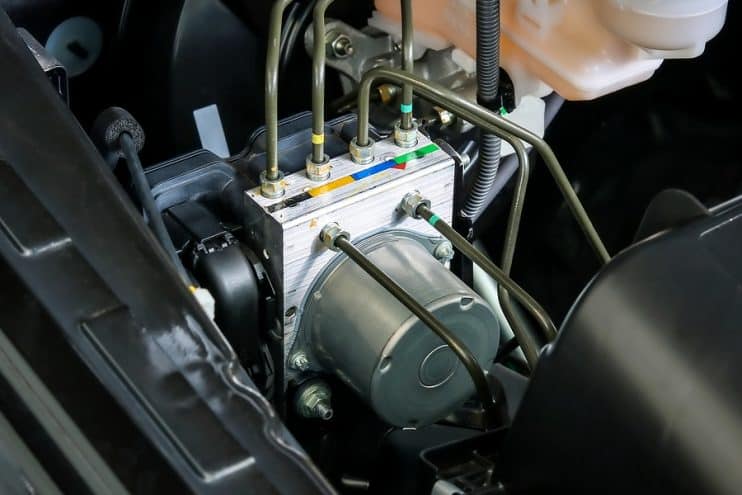

When an anti-lock braking system fails, it rarely does so with subtlety. A cluster of warning indicators—the amber ABS symbol, the traction control icon, and occasionally the red primary brake warning light—illuminates the instrument panel all at once. In some vehicles, the failure announces itself through more alarming mechanical symptoms: an electric pump motor that buzzes incessantly even after the key is removed from the ignition, a brake pedal that suddenly feels rock-hard underfoot, or a pedal that slowly sinks toward the floorboards during normal stops.
The trip to the repair facility usually ends with a staggering estimate. The service advisor will deliver the grim diagnosis that the vehicle requires a complete ABS hydraulic control unit replacement, presenting a repair invoice that routinely ranges between two thousand and four thousand dollars.
For the owner of a late-model car, that estimate represents an agonizing financial hit; for the driver of a vehicle that is eight to fifteen years old, the cost of a factory replacement can easily exceed half the fair market value of the entire car. Faced with this expense, motorists find themselves choosing between two distinct paths: buying a brand-new factory assembly or contracting an electronic rebuild service to remanufacture the original unit.
Anatomy of the ABS Assembly: Electronics vs. Hydraulics
To make an informed choice, you must understand what this component actually does and where the failure originates. What technicians broadly label as an “ABS pump” is actually a complex, multi-part electro-hydraulic assembly consisting of three integrated modules:
-
The Electronic Control Unit (ECU): The computerized brain of the assembly. It houses a micro-controller, solid-state relays, and electromagnetic solenoids. It continuously monitors wheel speed sensors, steering angle data, and lateral acceleration to detect the exact millisecond a tire loses traction.
-
The Hydraulic Control Unit (HCU): The machined aluminum valve block directly connected to your primary brake lines. Inside this block sits a labyrinth of microscopic fluid passages, spring-loaded shuttle valves, and accumulators that mechanically modulate brake line pressure.
-
The Electric Return Pump Motor: A high-output DC motor attached to the side of the aluminum block that rapidly forces compressed brake fluid back up to the master cylinder during active anti-lock events.
When an ABS unit fails, vehicle owners often assume the entire physical mechanism has worn out. In reality, the vast majority of failures are isolated to one specific half of the equation.
Roughly eighty percent of ABS breakdowns in modern vehicles are purely electronic. The unit is typically bolted into the engine bay, where it is subjected to brutal operating conditions: thousands of thermal expansion cycles from radiant exhaust heat, constant road vibration, and seasonal moisture. Over time, the lead-free solder joints on the internal circuit board crack, microscopic wire bonds separating the processor from the terminal pins fracture, or internal transistors driving the electric pump motor overheat and short out.
Mechanical hydraulic failures do occur, but they are almost always the direct result of neglected brake fluid maintenance. Water-saturated, acidic fluid corrodes the internal steel shuttle valves inside the aluminum block, causing them to bind in an open or closed position.
The New Factory Assembly: Zero Wear at a Steep Premium
Purchasing a brand-new original equipment manufacturer (OEM) assembly is the traditional path recommended by dealership service bays. The advantages of this approach are straightforward. You receive a virgin component with zero operational wear, fresh internal seals, brand-new solenoids, and a factory warranty backing the hardware. If the internal failure was caused by mechanical debris or valve scoring within the hydraulic block, a new assembly guarantees that the entire hydraulic pathway is clean.
However, the new OEM route carries immense financial and logistical drawbacks that extend beyond the initial purchase price of the part.
The primary hidden obstacle is software programming and VIN coding. Modern ABS modules are integrated directly into the vehicle’s controller area network (CAN bus) and immobilizer system. You cannot simply install a new factory module and drive away; it arrives from the parts warehouse as an unprogrammed blank slate.
A technician must connect a high-level, subscription-based diagnostic scan tool to flash the specific vehicle calibration file, marry the new module to the car’s unique vehicle identification number, and calibrate the steering angle and yaw rate sensors. If you attempt this repair in your home garage, you will still need to tow the car to a dealership or hire a mobile diagnostic technician to execute the initial software flash before the system will operate.
Furthermore, for older vehicles, sourcing a brand-new factory unit is often impossible. Automakers routinely discontinue specialized electronic modules seven to ten years after a production run ends. If the dealer parts catalog lists the assembly as discontinued or indefinitely backordered, buying new ceases to be an option.
The Rebuild and Remanufacturing Alternative
The persistent failure rates of modern ABS units have fueled a specialized automotive industry: dedicated electronic and hydraulic remanufacturing houses. Rather than replacing the entire component with an expensive new part that shares the same original factory design flaws, professional rebuilders take your existing unit and repair the specific failure points.
The remanufacturing process is a precision surgical procedure. Specialized technicians cut open the hermetically sealed plastic casing of the electronic module using specialized micro-milling equipment. Under high-magnification stereomicroscopes, they strip away defective silicone potting gel and inspect the circuit board.
High-grade rebuild services do not merely resolder the cracked joint that caused the failure code; they systematically address the root vulnerabilities:
-
Replacing delicate factory aluminum micro-wire bonds with resilient, heavy-gauge copper or gold wiring.
-
Reflowing thermal stress points with flexible, leaded solder compounds that resist future heat-cycling fractures.
-
Replacing factory pump-driver MOSFET transistors with upgraded, heavy-duty components capable of handling higher electrical current loads.
-
Ultrasonic cleaning of the hydraulic valve block, replacing internal elastomeric seals, and testing the pump motor brushes.
The greatest practical advantage of choosing a rebuild service is that your module retains its original programming. Because the remanufacturer repairs your existing hardware, the vehicle’s VIN, options coding, tire size parameters, and sensor calibrations remain untouched. When the unit returns to you, it is completely plug-and-play. You bolt it into place, reconnect the harness, perform a standard hydraulic brake bleed, and the dashboard error lights extinguish without requiring expensive dealer re-flashing.
Deciding Between Module-Only Removal and Full Unit Service
If you decide to pursue a rebuild, check whether the electronic control module can be detached from the hydraulic valve block while the unit is still in the engine bay.
On many popular platforms, the electronic module is secured to the aluminum block by four to six external Torx screws. If your diagnostic trouble codes point strictly to electronic faults—such as an open circuit code for a specific solenoid, a missing wheel speed sensor signal that tested fine at the hub, or an internal memory fault—you can often unbolt the black plastic electronic box and slide it off the valve block without disconnecting a single steel brake line.
This is a massive operational win. Your braking system remains hydraulically sealed, meaning you do not have to drain the fluid, wrestle with seized flare nuts on hard brake lines, or run a pressurized hydraulic bleed routine when the part returns.
If your diagnostic codes point to a seized pump motor, a stuck valve, or an internal hydraulic pressure imbalance, the entire assembly must be removed. This requires disconnecting all primary and secondary brake lines and capping them to prevent contamination. When reinstalling a fully serviced hydraulic block, a standard manual two-person brake bleed is rarely sufficient. You will need a scan tool capable of initiating an automated ABS bleed procedure, which electronically cycles the internal solenoids and runs the return pump to purge trapped air bubbles from the deepest passages of the valve body.
The Trade-Offs: Downtime vs. Out-of-Pocket Cost
Choosing between a rebuild and a new assembly ultimately comes down to balancing financial savings against practical vehicle downtime.
A new assembly installation can typically be completed within twenty-four to forty-eight hours, provided the part is sitting on a local warehouse shelf. It is the fastest route to getting a daily driver back on the road if you cannot afford logistical disruption.
A rebuild service requires patience. You must remove the unit, package it securely with electrostatic protection, ship it to a specialized facility, wait for bench testing and repair, and wait for return shipping. Even with expedited shipping, your car will sit immobilized on jack stands or in a repair bay for three to seven business days.
In exchange for that downtime, the cost difference is dramatic. While a new factory assembly and dealership programming easily exceeds two thousand dollars, sending an ABS module out to a reputable rebuild house typically costs between two hundred and fifty and four hundred and fifty dollars. For an aging vehicle, that seventeen-hundred-dollar difference transforms a potential financial write-off into a sensible, cost-effective repair.
Before committing to either route, ensure your diagnosis is rock-solid. Corroded ground wires, blown high-amperage ABS fuses, damaged wheel bearing reluctor rings, and low system voltage from a dying vehicle battery can mimic ABS control unit failures with astonishing accuracy. Once a verified diagnostic scan confirms that the fault lies deep inside the assembly, an upgraded professional rebuild provides the ideal intersection of long-term reliability, plug-and-play convenience, and financial sanity.
Comments are closed.