
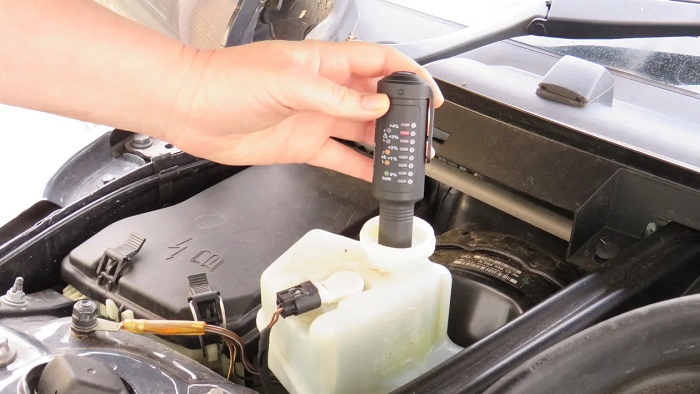

You pull into an auto repair shop for a routine oil change and tire rotation. Twenty minutes later, the service advisor walks into the waiting room holding a small plastic vial or a pen-shaped electronic gadget. They point to the dark fluid in the reservoir or flash a glowing red warning light and deliver the familiar pitch: your brake fluid is dangerously dirty, and you need an immediate system flush for an extra hundred and fifty dollars.
For most drivers, this interaction sparks instant hesitation. You want your vehicle to stop safely, but you also know that fluid flushes represent some of the highest-margin services on a repair shop’s menu. Dark color alone is a notoriously unreliable indicator of fluid degradation. To avoid paying for a service you do not need—while ensuring your braking system remains safe under extreme conditions—you have to understand how technicians test for brake fluid moisture and what those readings actually mean.
The Science of Brake Fluid and Water Infiltration
Modern hydraulic brakes operate on a simple physical principle: liquids do not compress. When you press the brake pedal, the master cylinder forces brake fluid through rigid steel lines and flexible rubber hoses to the calipers at each wheel. That hydraulic pressure clamps the brake pads against the spinning rotors, converting kinetic energy into intense friction and heat.
Standard automotive brake fluids, specifically DOT 3, DOT 4, and DOT 5.1, are glycol-ether-based chemical compounds designed to withstand immense pressure and high operating temperatures without boiling. However, glycol-based fluids possess an inherent chemical vulnerability: they are hygroscopic. This means they actively absorb moisture directly from the surrounding atmosphere.
Water does not need a visible leak to enter your braking system. Microscopic moisture molecules penetrate through the micropores of flexible rubber brake hoses, seep past the rubber seals in the calipers and wheel cylinders, and enter through the reservoir vent whenever the hood is opened. Over two to three years of normal driving, a vehicle’s brake fluid naturally absorbs roughly two to four percent water content.
The danger of moisture is thermal. Pure, fresh DOT 3 brake fluid features a dry boiling point of at least 401 degrees Fahrenheit, while DOT 4 boils at a minimum of 446 degrees Fahrenheit. As moisture infiltrates the system, that boiling threshold plummets. When brake fluid absorbs just 3.7 percent water, its wet boiling point drops to roughly 284 degrees Fahrenheit for DOT 3.
Under hard braking, such as descending a steep mountain grade or executing sudden stops on the highway, brake calipers easily surpass three hundred degrees. If contaminated fluid hits its wet boiling point, the water turns into steam. Unlike liquid, steam is compressible gas. When you press the pedal, you compress steam bubbles instead of pushing fluid, causing the pedal to sink straight to the floorboards in a terrifying phenomenon known as vapor lock.
The Testing Tools Technicians Use
Because you cannot judge the water content of a chemical solution with the naked eye, technicians rely on specific diagnostic tools to measure degradation. Understanding which tool the technician used is the first step in evaluating their recommendation.
Electronic Conductivity Pens
The most common tool on the service drive is a pen-shaped conductivity tester equipped with two metal prongs. The technician dips the prongs into the master cylinder reservoir, presses a button, and reads a series of LED lights.
These devices operate on the principle of electrical resistance. Pure glycol-ether fluid is a poor electrical conductor, while water conducts electricity relatively well. As water content increases, electrical resistance between the two prongs drops, triggering sequential green, yellow, and red indicator lights.
While convenient, conductivity pens are prone to distortion. They do not measure moisture directly; they estimate it based on conductivity. If the fluid contains dissolved copper from deteriorating brake lines or aftermarket additives, the pen can register elevated conductivity and flash a red warning even if moisture levels remain well within safe limits.
Optical and Thermal Boiling Point Analyzers
Thermal boiling analyzers represent the gold standard of brake fluid diagnostics. Instead of estimating water content through electrical conductivity, these specialized devices draw a small fluid sample from the reservoir, heat it inside an enclosed testing chamber until it boils, and measure the exact temperature of the phase change.
If a shop uses a thermal tester, the reading eliminates all guesswork. If your DOT 3 fluid boils at 380 degrees Fahrenheit, it is in excellent condition. If it boils below 300 degrees Fahrenheit, it is dangerously compromised, and no technician can fabricate that physical threshold.
Chemical Test Strips
Some repair shops use chemical test strips that measure dissolved copper content rather than direct water percentage. As brake fluid absorbs moisture, its factory corrosion inhibitors break down, allowing the fluid to chemically attack the copper brazing lining the interior of steel brake lines.
The technician dips the paper strip into the reservoir and compares the color change against a parts-per-million (ppm) chart. These strips test the chemical age and corrosion potential of the fluid rather than its instantaneous boiling point.
Interpreting the Numbers: When to Flush and When to Wait
When a service advisor presents you with a test result, look past the colored lights and demand the numerical reading. The industry recognizes distinct action thresholds based on measured moisture content:
-
Less than 1 percent moisture: The fluid is in pristine condition. A flush is completely unwarranted.
-
1 to 2 percent moisture: The fluid is operating within normal parameters. This is typical for a vehicle driven for twelve to eighteen months. The boiling point remains comfortably above safe operating thresholds. Decline the flush.
-
3 percent moisture: This is the universal transitional threshold. At three percent water content, the fluid has lost roughly twenty-five to thirty percent of its original boiling resistance. Most vehicle manufacturers recommend scheduling a flush at this stage, particularly if you tow trailers, drive in hilly terrain, or live in a humid coastal environment.
-
4 percent moisture or higher: The fluid is critically saturated. Its boiling point has dropped to near-boiling water levels, and the fluid has become acidic enough to pit ABS valves and caliper pistons. You should approve a system flush immediately.
If the shop uses chemical copper test strips, the industry standard established by the Motorist Assurance Program (MAP) sets the replacement threshold at 200 parts per million of dissolved copper. Any reading below 100 ppm indicates healthy corrosion inhibitors. A reading between 100 and 200 ppm warrants monitoring at your next service, while a reading exceeding 200 ppm indicates that the fluid’s protective chemistry is depleted and component corrosion is actively occurring.
The Trap of the Visual Inspection
The most frequent upselling tactic relies on visual bias. A service advisor will pull a syringe of dark, amber fluid from your reservoir, compare it to a bottle of crystal-clear new fluid, and claim that the dark coloration proves the fluid is ruined.
Color is not a reliable indicator of moisture or hydraulic failure. Brake fluid naturally darkens over time due to microscopic particles of carbon and rubber shedding from the master cylinder piston seals, alongside minor thermal cycling. Fluid can turn tea-colored within six months of installation while maintaining less than one percent moisture and a rock-solid four-hundred-degree boiling point.
Conversely, brake fluid can sit in a humid garage for three years, absorb dangerous amounts of invisible water vapor, and remain entirely clear and straw-colored. Never authorize a hundred-and-fifty-dollar hydraulic service based on visual appearance alone.
Practical Questions to Ask Before Approving Service
When a repair shop recommends a brake fluid flush, step out of the customer lounge and ask three clarifying questions:
-
“What specific moisture percentage did the fluid register?” If the advisor cannot give you a number and merely repeats that the fluid “looks dirty,” decline the service until it is tested properly.
-
“What testing tool was used to evaluate the fluid?” If they used an entry-level conductivity pen, ask whether they tested for copper ppm or checked the boiling point, especially if the vehicle is relatively new.
-
“Can you show me the test reading on the vehicle?” A reputable mechanic has no problem walking you into the service bay and dipping a tester or strip into the reservoir in your presence.
A brake fluid flush is not a scam; it is a vital preventative maintenance service that protects expensive anti-lock brake modulators and prevents sudden hydraulic failure. The key is making sure you purchase the service when the fluid’s physical chemistry demands it, rather than when a shop’s sales quota needs a boost.
Comments are closed.